
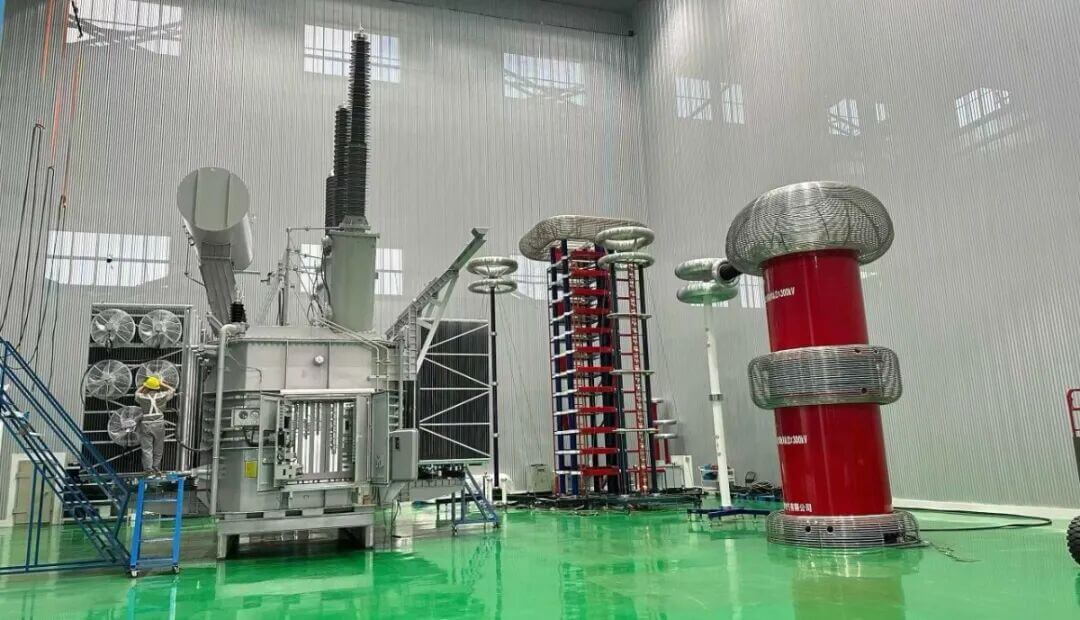
The switching impulse withstand test is specially designed to simulate switching overvoltages generated during grid switching operations and fault tripping, to verify the actual capability of transformer insulation to withstand transient impulse voltages. For EHV transformers of 220 kV and above, this test cannot be equivalently replaced by the 1-minute power-frequency withstand voltage test, with four core reasons as follows:
1. Complete Mismatch in Voltage Frequency and Waveform Characteristics
Actual grid switching overvoltages are damped oscillatory transient waves with an equivalent oscillation frequency up to several kilohertz, showing drastic differences from the 50 Hz power-frequency alternating current waveform. Under high-frequency transient voltages, the electric field distribution and capacitive voltage division rules of the main and longitudinal insulation of EHV transformers differ fundamentally from those under low-frequency power-frequency voltages. The power-frequency test fails to reproduce the actual voltage stress encountered in field operation.
2. Order-of-Magnitude Gap in Voltage Duration
A standard switching impulse lasts only hundreds to thousands of microseconds, constituting an instantaneous surge. In contrast, the 1-minute power-frequency withstand test sustains voltage application for 60 seconds — a duration tens of millions of times longer than real switching overvoltages. Prolonged power-frequency energization causes continuous heat accumulation and cumulative damage from partial discharge, leading to severe deviation between test conditions and real instantaneous overvoltage scenarios; hence test results lack practical reference value.
3. Fundamental Differences in Insulation Breakdown Mechanism and Discharge Path
Under switching impulse voltage, breakdown of transformer oil gaps and paper insulation is dominated by instantaneous electric field breakdown and the full-voltage effect of long gaps, with flashover and breakdown channels concentrated at winding terminals and long inter-phase insulation gaps. By contrast, breakdown under prolonged power-frequency voltage is mostly induced by long-term erosion from partial discharge and thermal aging. The two test modes expose entirely different weak insulation points. For equipment rated 220 kV and above, the breakdown threshold of long air gaps and multi-layer composite oil-paper insulation under impulse voltage is markedly lower than that under power-frequency voltage. Relying solely on power-frequency withstand testing will fail to detect insulation defects triggered by impulse operating conditions.
4. Equivalence Failure Determined by Insulation Design Features of EHV Equipment
Medium and low-voltage transformers of 220 kV and below feature sufficient insulation margin, so the power-frequency withstand test can approximately assess their resistance to switching overvoltages. However, to control manufacturing costs, EHV transformers of 220 kV and above are designed with a low insulation margin, and their insulation level is defined primarily by switching impulse withstand specifications. If only the 1-minute power-frequency withstand test is performed, the insulation reliability under short-duration, high-amplitude switching impulses cannot be validated. After commissioning, such transformers are prone to insulation flashover or breakdown faults triggered by system switching overvoltages, posing critical operational safety hazards.
Conclusion
In accordance with standard GB/T 1094.3, transformers rated 220 kV and above must undergo a separate switching impulse withstand test, which shall not be simplified or substituted by the power-frequency withstand test. This full test suite fully covers insulation assessment requirements across all operating conditions of the equipment.
Contact Yawei Transformer to get full switching impulse withstand test report for your transformers。